10 Years of Fan Letter: How a K-Musical About 1930s Writers Conquered Asia and Beyond
The beloved faction musical opens its 10th anniversary encore run in Daehangno with immersive fan events that blur the line between fiction and reality
 By Jang Hojin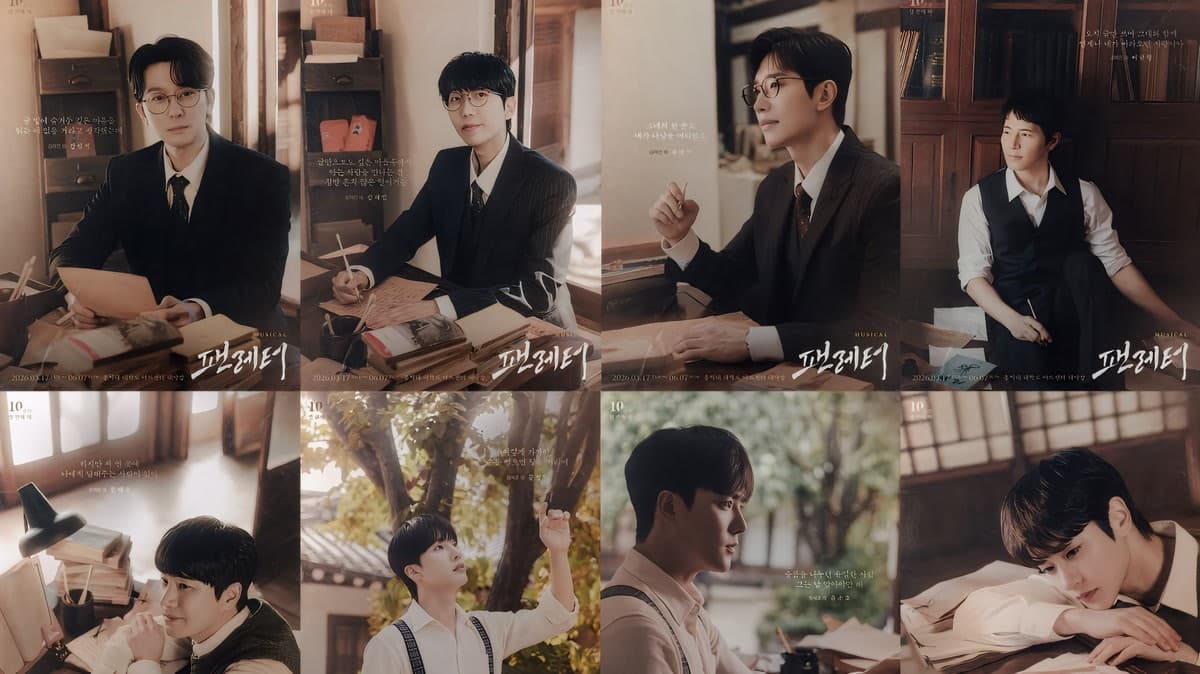
In the world of Korean musicals, few productions carry the weight of a decade-long legacy. Fan Letter, the faction musical inspired by the real-life literary circle Guinhoe of 1930s colonial Korea, opened its 10th anniversary encore run on March 17 at Hongik University Daehangno Art Center in Seoul — and the production company has gone to extraordinary lengths to make sure audiences feel like they are stepping directly into the story.
The Real History Behind the Fiction
To understand why Fan Letter resonates so deeply, one must first understand the turbulent era it portrays. In the 1930s, Korea was under Japanese colonial rule, and Korean writers faced extraordinary pressure — censorship, identity erasure, and the constant threat of suppression. Yet this period paradoxically produced some of Korea's most brilliant literary voices, writers who channeled the anguish of a colonized nation into works of startling beauty and defiance.
At the center of Fan Letter's narrative are fictionalized versions of two towering figures from this era: Kim Yu-jeong and Yi Sang. Kim Yu-jeong, who died tragically young at 29 from tuberculosis in 1937, was celebrated for his warmly humorous short stories depicting rural Korean life — works like "Spring, Spring" and "The Camellias" that remain staples of Korean literature curricula today. Yi Sang, meanwhile, was the enfant terrible of Korean modernism, an architect-turned-writer whose experimental poetry and prose shocked the literary establishment and whose own death at 26 in a Tokyo hospital cemented his status as a tragic genius.
The Guinhoe — literally the "Circle of Nine" — was a real literary society that brought together these and other writers in 1930s Seoul. They gathered in the teahouses and cafes of Jongno, debating art, politics, and the future of Korean literature under the shadow of empire. Fan Letter takes this historical foundation and weaves through it a fictional love story, creating what Koreans call a "faction" work — a genre blending fact and fiction that has become increasingly popular in Korean cultural productions.
A Decade of Letters, Art, and Devotion
First premiered in 2016, Fan Letter tells the story of genius novelist Kim Hae-jin, aspiring writer Jeong Se-hun, and Hikaru — Hae-jin's enigmatic muse and a writer shrouded in mystery. Drawing its narrative from the literary friendships and rivalries of these real 1930s Korean authors, the musical weaves fiction and history into a compelling story about artistic passion, unrequited love, and the power of the written word.
Over the past decade, Fan Letter has built something rare in the Korean musical theater world — a dedicated and passionate fanbase that returns season after season. The production's appeal lies not just in its story but in its atmospheric score, which blends period-appropriate jazz and classical influences with contemporary musical theater sensibilities. The intimate emotional performances have made it a must-see for theater enthusiasts across Asia. Its 10th anniversary run at the prestigious Seoul Arts Center earlier in February closed to sold-out audiences, setting the stage for this Daehangno encore.
Daehangno itself is significant — the neighborhood in Seoul's Jongno district has been Korea's theater capital since the 1980s, home to over 150 small and medium-sized theaters. For a musical to earn a Daehangno encore after a Seoul Arts Center run is a mark of both commercial success and artistic credibility, signaling that the production has the staying power to fill seats in a more intimate setting where audience connection is everything.
Immersive Events That Bring the Story to Life
Production company Live Inc. has crafted a series of narrative-driven events that transform the theatergoing experience into something far more immersive than a typical pre-show activity. On March 4, the company hosted a birthday party for the fictional character Hikaru, complete with manuscript-shaped cookies and postcards. Four actresses who play Hikaru — So Jeong-hwa, Kang Hye-in, Lee Bom-sori, and Heo Yun-seul — attended personally, greeting fans in character.
What made the event truly special was the audience participation. Fans arrived dressed in Hikaru's stage costumes — newsboy caps, white blouses with flare skirts, cape coats, red dresses, and corsages — following a pre-announced dress code that turned the theater lobby into a living tableau from the show. The sight of dozens of fans embodying the character they love spoke volumes about the depth of engagement Fan Letter has cultivated over the years.
On March 10, a "Letter Messenger" event celebrated the fictional date of Se-hun's return to Korea. Four staff members dressed in Se-hun's signature green vests roamed the Daehangno neighborhood, and fans who found them and handed over a letter addressed to the cast received manuscript cookies and a 40 percent discount on tickets. The event effectively extended the musical's world beyond the theater walls and into the streets of one of Seoul's most beloved cultural districts.
For opening night on March 17 — which coincides with the fictional date when Kim Hae-jin leaves his final letter to Se-hun — a three-day event is running through March 19. Ticket holders for those performances will receive a handwritten letter crafted by the actors who play Kim Hae-jin, connecting audiences to the show's central theme of correspondence as a vessel for emotion.
A Pop-Up Space Where Fiction Meets Reality
Adding another layer to the experience, a pop-up zone called the Myeongil Ilbo Editorial Office has opened on the sky bridge of Hongik University Daehangno Art Center. Named after the fictional newspaper in the musical, the space includes a merchandise shop, a letter-writing corner, a reading area featuring books from the Guinhoe literary circle that inspired the show, and a viewing corner where visitors can watch archival performance footage and listen to the musical's score from across all ten seasons.
The pop-up is designed to serve as a gathering space where audiences can linger before and after performances, extending the emotional experience of the show beyond the two hours spent in the theater. It represents a growing trend in Korean musical theater where productions invest in creating comprehensive cultural experiences rather than simply staging performances — a strategy that mirrors how K-pop companies build fan engagement ecosystems around their artists.
Powerhouse Performances Across Ten Seasons
One of Fan Letter's greatest strengths has been its rotating cast system, a hallmark of Korean musical theater that allows audiences to experience the same story through different performers' interpretations. The 10th anniversary season features an impressive ensemble: Kang Pil-seok, Kim Jae-beom, Kim Kyung-su, and Lee Gyu-hyung as Kim Hae-jin; Moon Tae-yu, Moon Seong-il, Yoon So-ho, and Hong Ki-beom as Jeong Se-hun; and So Jeong-hwa, Kang Hye-in, Lee Bom-sori, and Heo Yun-seul as Hikaru.
This multi-cast approach means that dedicated fans attend multiple performances to see how different actors bring distinct emotional textures to the same scenes. The chemistry between performers can shift the entire tone of the piece — one Hae-jin might emphasize the character's brooding intensity while another highlights his wry humor, and each Hikaru brings a different shade of mystery and vulnerability to the role. Over ten seasons, this system has produced legendary cast combinations that fans discuss and rank with the same fervor that K-pop fans debate their favorite group formations.
From Daehangno to the World: The K-Musical Wave
Fan Letter's ambitions extend well beyond Seoul's theater district. Over the past decade, the musical has expanded into international markets, with productions staged in Taiwan, China, and Japan. Perhaps most notably, the show completed a showcase in London, England — a significant milestone for any Korean original musical seeking a foothold in the West.
This global trajectory has positioned Fan Letter as one of the leading examples of the K-Musical wave, a cultural export movement that parallels the rise of K-drama and K-pop but operates on a smaller, more intimate scale. While K-pop fills stadiums and K-dramas dominate streaming platforms, K-musicals are quietly building international audiences through touring productions, licensed adaptations, and festival showcases. Productions like Fan Letter, along with titles such as The Last Kiss, Gwanghwamun Sonata, and Xcalibur, are demonstrating that Korean musical theater possesses a distinctive creative voice — one that blends Eastern storytelling traditions with Western musical theater forms in ways that feel genuinely fresh.
The Korean musical theater industry has grown dramatically over the past two decades, with the domestic market now valued at hundreds of billions of won annually. Original Korean musicals — as opposed to licensed productions of Broadway or West End shows — have become an increasingly important segment of this market, and Fan Letter's decade of success stands as proof that homegrown stories can compete with and even surpass imported productions in audience loyalty.
A Living Testament to the Power of Stories
The encore run at Hongik University Daehangno Art Center will continue through June 7, 2026, giving audiences nearly three months to experience a production that has become one of Korean musical theater's most enduring and beloved works. For those who have followed Fan Letter since its debut, the 10th anniversary is not just a celebration of a show — it is a testament to the enduring power of stories told through music, letters, and the unbreakable bond between performers and their audience.
In an era when entertainment is increasingly consumed through screens and algorithms, Fan Letter reminds us that there is something irreplaceable about gathering in a darkened theater to watch live performers breathe life into characters inspired by real people who lived, loved, and wrote nearly a century ago. The letters these fictional characters exchange on stage carry the same weight as the real manuscripts that Kim Yu-jeong and Yi Sang once penned in the teahouses of colonial Seoul — fragile documents that somehow survived war, division, and the passage of time to speak to audiences who were not yet born when the ink first dried.
How do you feel about this article?
저작권자 © KEnterHub 무단전재 및 재배포, AI학습 및 활용 금지
Entertainment Journalist · KEnterHub
Entertainment journalist specializing in K-Pop, K-Drama, and Korean celebrity news. Covers artist comebacks, drama premieres, award shows, and fan culture with in-depth reporting and analysis.
Comments
Please log in to comment