NMIXX Makes History With Sold-Out Japan Debut: Why MIXX POP Is K-Pop's Most Viable Export Experiment
Two nights, 21,300 fans, and one Aimyon cover: NMIXX's CHANGE UP: MIXX LAB tour lands in Tokyo as proof that JYP's most experimental act has found its global audience
 By Park Chulwon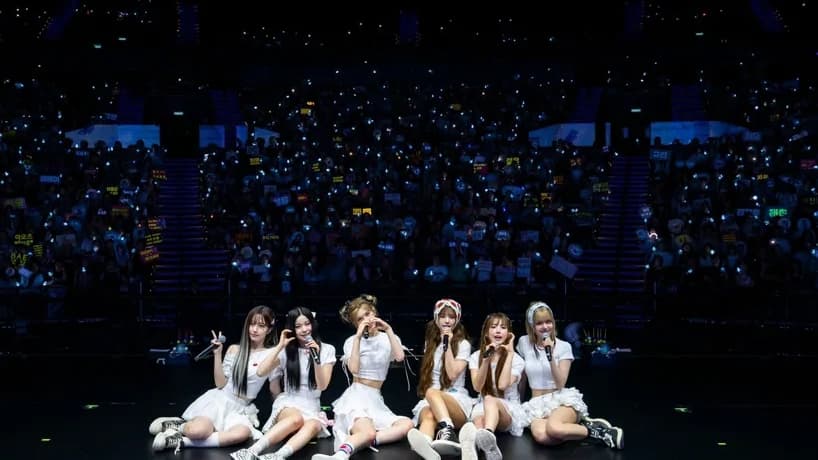
NMIXX opens their first-ever solo concert in Japan today, selling out two nights at LaLa Arena Tokyo Bay and drawing 21,300 fans. The milestone marks a turning point for JYP Entertainment's most experimentally ambitious act — proof that the genre-defying MIXX POP concept can fill arenas, not just divide comment sections. Two years after a polarizing debut split the K-pop fandom, NMIXX has found its international audience, and Japan is where they are claiming it loudest.
From Shock Value to Staying Power: NMIXX's Journey
When NMIXX debuted on February 22, 2022 under JYP Entertainment, the reaction was immediate and noisy. "O.O," their debut single, deliberately shifted between musical styles mid-track — a structural choice that baffled listeners accustomed to the seamlessness of conventional K-pop production. Some called it chaotic. Others called it ahead of its time. JYP called it MIXX POP: a genre philosophy built on genre collision rather than genre comfort.
The concept was a calculated risk. MIXX POP asked audiences to hold contradictions in a single listening experience — hip-hop transitions into pop euphoria, ballad softness erupts into percussion-heavy drop. For a fandom culture trained on cohesion, it was genuinely difficult to process. The debate around "O.O" became, paradoxically, NMIXX's most powerful early marketing engine: polarization generated conversation, and conversation generated streams.
What followed was a slow, deliberate accumulation of audience loyalty. "DASH," with its propulsive energy and vocally demanding arrangement, demonstrated that the group could move a crowd. "Love Me Like This" proved NMIXX could command a more accessible pop moment without abandoning their identity. Then came 2024's "Soñar (Breaker)" — perhaps the clearest signal yet that the seven members of NMIXX (Lily, Haewon, Sullyoon, Bae, Jiwoo, and Kyujin, following Jinni's departure in December 2022) had matured from a fascinating experiment into a fully realized performing act. By the close of 2024, NMIXX was no longer a group people were figuring out. They were a group people were following.
Why Japan — And Why It Matters Now
Japan occupies a structurally unique position in K-pop's global expansion. It is the world's second-largest recorded music market, a territory where multiple generations of K-pop acts — from BoA to TVXQ to TWICE — have built parallel, often more lucrative fanbases than in their home country. For JYP Entertainment in particular, Japan has historically served as a critical proving ground: TWICE's Japanese activities became a significant revenue pillar well before the group achieved broader Western crossover recognition.
Against that backdrop, NMIXX selling out two nights at LaLa Arena Tokyo Bay — a 10,600-capacity venue in Funabashi — is not a minor data point. It is a commercial signal. The 21,300 total attendees across January 11 and 12 represent demand that exceeds a typical mid-tier showcase event; this is arena-scale validation in the strictest sense. More precisely, it demonstrates that NMIXX's fanbase in Japan — the "NSWER" community — has reached the density and engagement required to sustain solo headline touring, independent of any domestic charting event or viral moment.
The MIXX POP concept carries particular resonance in the Japanese market, where genre fusion has a longer cultural acceptance curve. Japanese music fans, shaped by decades of exposure to city pop's hybrid aesthetics and J-pop's embrace of Western-influenced production, are arguably more receptive to formal experimentation than some other markets. NMIXX arriving in Tokyo not as a stripped-down version of themselves but as the full MIXX LAB experience — concept-driven, interactive, and theatrically ambitious — is a strategic alignment of group identity with audience sensibility that few 4th-generation acts have managed to execute at this scale.
The Setlist as Argument: What NMIXX Chose to Say
A concert setlist, for any act with a distinct sonic identity, is a curatorial statement. NMIXX's choice to open "CHANGE UP: MIXX LAB in Tokyo" with "Run For Roses" — a track associated with momentum and forward motion — was not incidental. It frames the evening as a declaration rather than a victory lap. The inclusion of "Soñar (Breaker)" and the kinetic "Young, Dumb, Stupid" alongside "DASH" and "별별별 (See that?)" created a set architecture that showcased NMIXX across their full tonal range: brash and restrained, theatrical and intimate, relentless and generous.
The most culturally deliberate moment arrived with their cover of Aimyon's "Marigold." Aimyon is not simply a popular Japanese singer-songwriter — she is the kind of artist whose music carries genuine emotional weight for an entire generation of Japanese listeners. NMIXX performing "Marigold" live in Tokyo is an act of cultural bridge-building executed at the level of repertoire, not merely stage production. It signals fluency, not just enthusiasm. Fans responded accordingly, and the moment became one of the most discussed highlights of night one across social media, circulating widely through NSWER communities well beyond Japan.
The interactive fan game segments built into the show reinforced a parallel message: that the "MIXX LAB" framework is designed to turn passive audiences into participants. It positions NSWER as collaborators in the NMIXX universe — a relationship dynamic that drives the sustained engagement required to fill venues two nights in a row, in a foreign market, as a group barely two years into its career.
Global Momentum: Latin America and Beyond
The Japan dates open a larger chapter. In February, NMIXX is set to continue "CHANGE UP: MIXX LAB" with stops in Mexico City, Santiago, and São Paulo — a Latin American leg that reflects both the global appetite for K-pop live experiences and NMIXX's growing footprint in Spanish-speaking markets, where "Soñar (Breaker)" resonated with particular intensity. The title itself — "Soñar," Spanish for "to dream" — was not an accident of branding; it was an early signal of the group's conscious international ambition.
What the Japan sold-out and the Latin America dates represent, taken together, is the emergence of a genuinely global touring infrastructure built not on one breakthrough single or a single viral moment, but on the steady accumulation of a fanbase that chose to grow alongside a group still becoming its fullest self. The MIXX POP experiment, it turns out, was never a liability. It was the foundation. And in Funabashi today, more than 10,000 voices singing back every lyric are the most articulate answer yet to everyone who said the concept was too complicated to export.
How do you feel about this article?
저작권자 © KEnterHub 무단전재 및 재배포, AI학습 및 활용 금지
Entertainment Journalist · KEnterHub
Entertainment journalist focused on Korean music, film, and the global K-Wave. Reports on industry trends, celebrity profiles, and the intersection of Korean pop culture and international audiences.
Comments
Please log in to comment