From K-Pop Stage to Concert Hall: How Seohyun's Violin Debut Silenced Every Critic
Seven months of 10-hour daily practice, a standing ovation, and the SNSD debut song reimagined by orchestra
 By Park Chulwon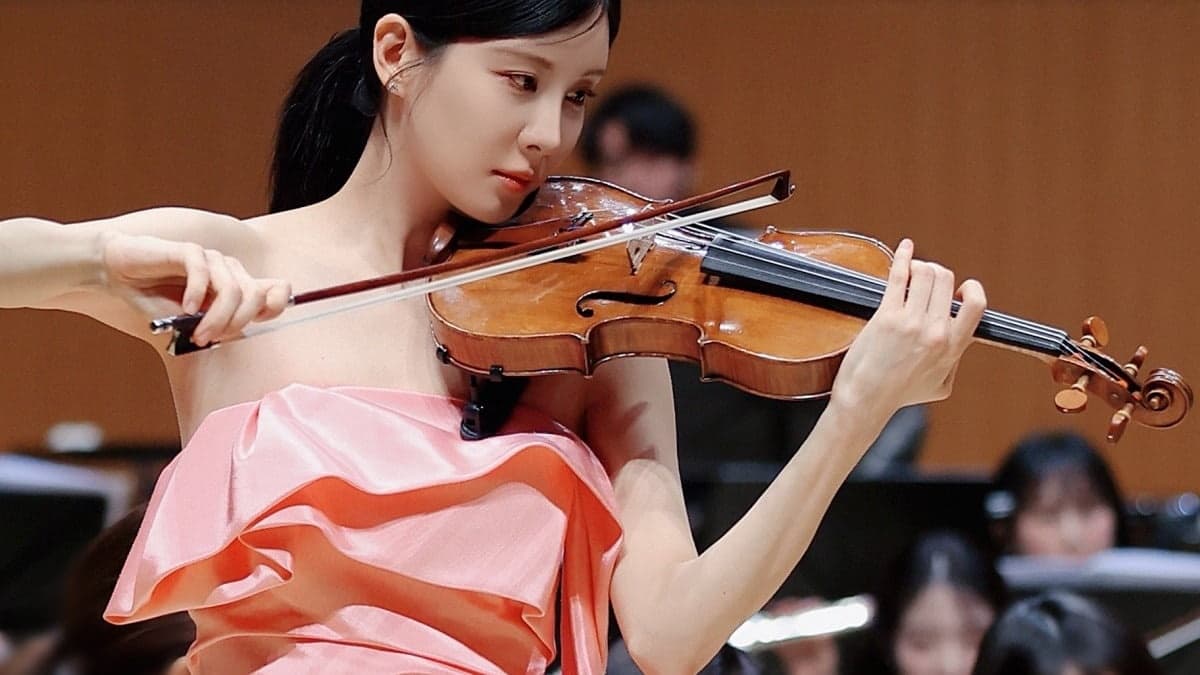
When Girls' Generation's Seohyun walked onto the Lotte Concert Hall stage on March 13 carrying a violin instead of a microphone, she wasn't just performing a concert. She was answering a question that had dogged her for weeks: does a K-pop idol deserve to stand on one of Korea's most prestigious classical stages?
The answer came not in words but in music — specifically, in a complete performance of Vittorio Monti's "Csárdás," one of the most technically demanding pieces in the violin repertoire, delivered to 2,000 audience members who responded with a standing ovation. But the real story isn't the applause. It's what the seven months leading up to that moment reveal about the evolving identity of K-pop artists and the increasingly porous boundary between popular and classical music in South Korea.
The Controversy That Preceded the Concert
Before Seohyun ever touched bow to string at Lotte Concert Hall, she faced a challenge no amount of practice could prepare her for. When news broke that the Girls' Generation member would perform as a special guest at the Sol Philharmonic Orchestra's 8th Regular Concert, a segment of the public pushed back hard. The accusation was blunt: celebrity privilege.
Critics questioned whether an idol — regardless of talent or preparation — belonged on the stage of a 2,000-seat venue typically reserved for trained classical musicians. The Korean term "특혜" (special treatment) trended in online discussions, with some arguing that Seohyun's fame, not her ability, had earned her the invitation. It was a familiar criticism in a country where the boundary between entertainment celebrity and artistic legitimacy remains fiercely guarded.
But the backlash also exposed a deeper tension. South Korea's classical music community has long struggled with declining audience numbers, particularly among younger demographics. The Sol Philharmonic Orchestra, an amateur ensemble, had specifically designed its concert around the theme of "pure passion for music" — a philosophy that welcomed performers at every level. Seohyun's participation wasn't a departure from that mission; it was its embodiment.
Seven Months, Ten Hours a Day
The numbers alone tell a story of commitment that went far beyond a celebrity appearance. Seohyun had studied violin for roughly four years as an elementary school student before her trainee life at SM Entertainment consumed all available hours. When she picked the instrument back up in August 2025, she was essentially starting over.
What followed was a preparation regimen that would challenge even dedicated conservatory students. Seohyun practiced eight to ten hours daily — a schedule she maintained alongside her acting career. Photos she later shared on Instagram showed blistered and calloused fingers; at one point, she bandaged her second finger with a splint, using it only during practice sessions to prevent further injury.
Her choice of repertoire made the commitment even more striking. Monti's "Csárdás" is not a beginner's piece. The composition demands rapid shifts between slow, expressive passages (the "lassan") and explosive, virtuosic sections (the "friss"), requiring precise intonation, aggressive bowing technique, and the kind of musical interpretation that typically takes years to develop. For an amateur returning to the instrument after a two-decade gap, it was an audaciously bold selection.
When "Into The New World" Met the Orchestra
The concert's most powerful moment didn't come from Monti. It came from an unlikely encore: Girls' Generation's 2007 debut single "Into The New World," reimagined as an orchestral arrangement with Seohyun on violin.
The symbolism was impossible to miss. A song that launched one of K-pop's most iconic careers was being performed in an entirely different musical language, on a stage built for Beethoven and Brahms. For the audience — many of whom had grown up with the song — the moment collapsed the distance between two worlds that Korean culture has traditionally kept separate. The resulting standing ovation wasn't just for the performance. It was for the audacity of the bridge itself.
This kind of crossover is still rare in South Korea, where classical and popular music occupy distinctly separate cultural territories. Unlike in the West, where artists like Lindsey Stirling have built careers blending violin with electronic music, Korean classical institutions have generally maintained stricter boundaries. Seohyun's concert didn't demolish those walls, but it opened a door — and the audience walked through it willingly.
The Bigger Picture: K-Pop Idols and Artistic Reinvention
Seohyun's violin debut fits into a broader, accelerating pattern of K-pop idols pursuing serious artistic endeavors beyond their original training. BTS's RM has become one of South Korea's most visible contemporary art collectors and museum patrons. EXO's D.O. has earned critical acclaim as a legitimate film actor. But classical music performance — with its unforgiving technical demands and its culture of rigorous credentialing — represents a fundamentally different kind of challenge.
What makes Seohyun's case particularly significant is the transparency of her preparation. She didn't present herself as a prodigy or a natural talent. She shared the blisters. She admitted the fear. In her Instagram post following the concert, she wrote that "the pressure and burden were honestly overwhelming" and that she had questioned whether she could pull it off at all. This vulnerability — rare in an industry built on polished perfection — may have done more to legitimize her performance than the performance itself.
The response from Korea's classical community reinforced this. World-renowned violinist Kim Bom-sori publicly expressed encouragement. A music professor defended Seohyun's participation, asking bluntly: "What exactly is the problem?" Classical enthusiasts noted that "a popular artist's meaningful gesture serves as a bridge that lowers the threshold of classical music" — an acknowledgment that the genre's survival may depend on exactly this kind of crossover.
Philanthropy as Proof of Intent
Perhaps the detail that most effectively neutralized the privilege criticism was the simplest one. Seohyun accepted no performance fee. She participated entirely as a talent donation, and the concert's proceeds were directed toward orchestras for people with disabilities and other socially vulnerable groups.
This wasn't a contractual obligation or a PR strategy. The Sol Philharmonic Orchestra confirmed that Seohyun had proactively proposed the charitable component. In a media landscape where celebrity philanthropy is often scrutinized for its sincerity, the combination of unpaid performance, genuine artistic risk, and charitable giving created a narrative that was difficult to criticize — and the public response reflected that shift.
What Comes Next
Whether Seohyun's violin career extends beyond a single concert remains to be seen. But the impact of March 13 has already rippled outward. The Sol Philharmonic Orchestra reported unprecedented ticket demand for a concert that might otherwise have drawn a fraction of that audience. Classical music conversations on Korean social media spiked measurably in the days following. And for the generation of fans who first encountered Seohyun through "Into The New World" nearly two decades ago, the concert offered proof of something they had always sensed: that the boundaries defining what a K-pop idol can become were never as fixed as the industry pretended.
Seohyun closed her Instagram reflection with a wish: "I hope classical music can be a little closer to more people's daily lives, as a small joy." On a March evening in Seoul, standing in a pink dress with calloused fingers and a borrowed confidence, she made that hope feel less like a wish and more like a promise already kept.
How do you feel about this article?
저작권자 © KEnterHub 무단전재 및 재배포, AI학습 및 활용 금지
Entertainment Journalist · KEnterHub
Entertainment journalist focused on Korean music, film, and the global K-Wave. Reports on industry trends, celebrity profiles, and the intersection of Korean pop culture and international audiences.
Comments
Please log in to comment